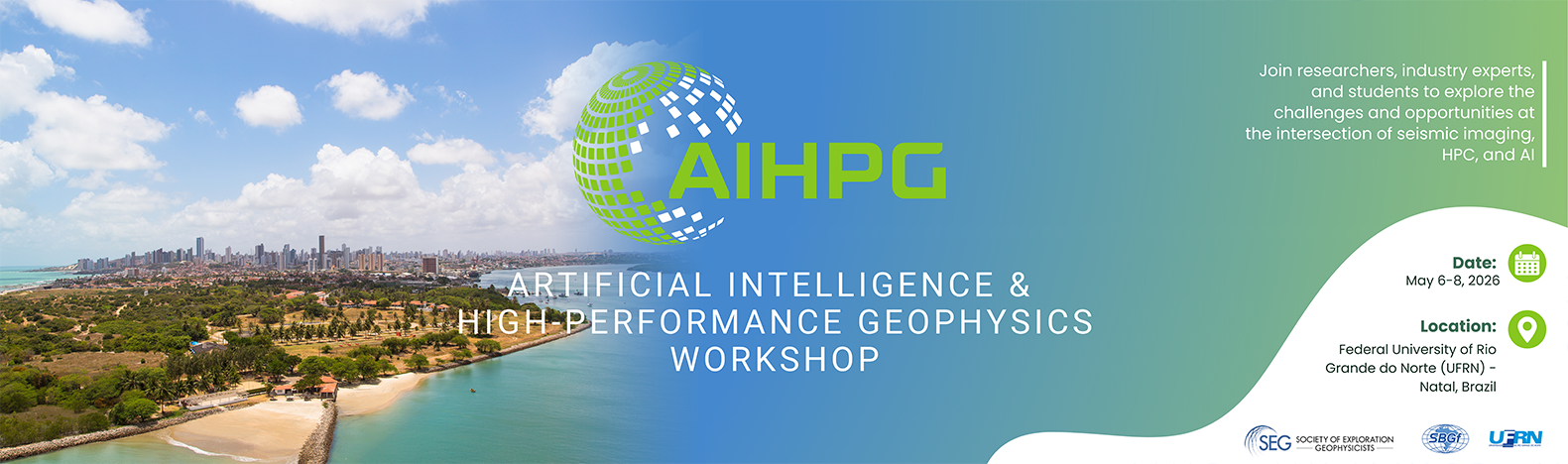
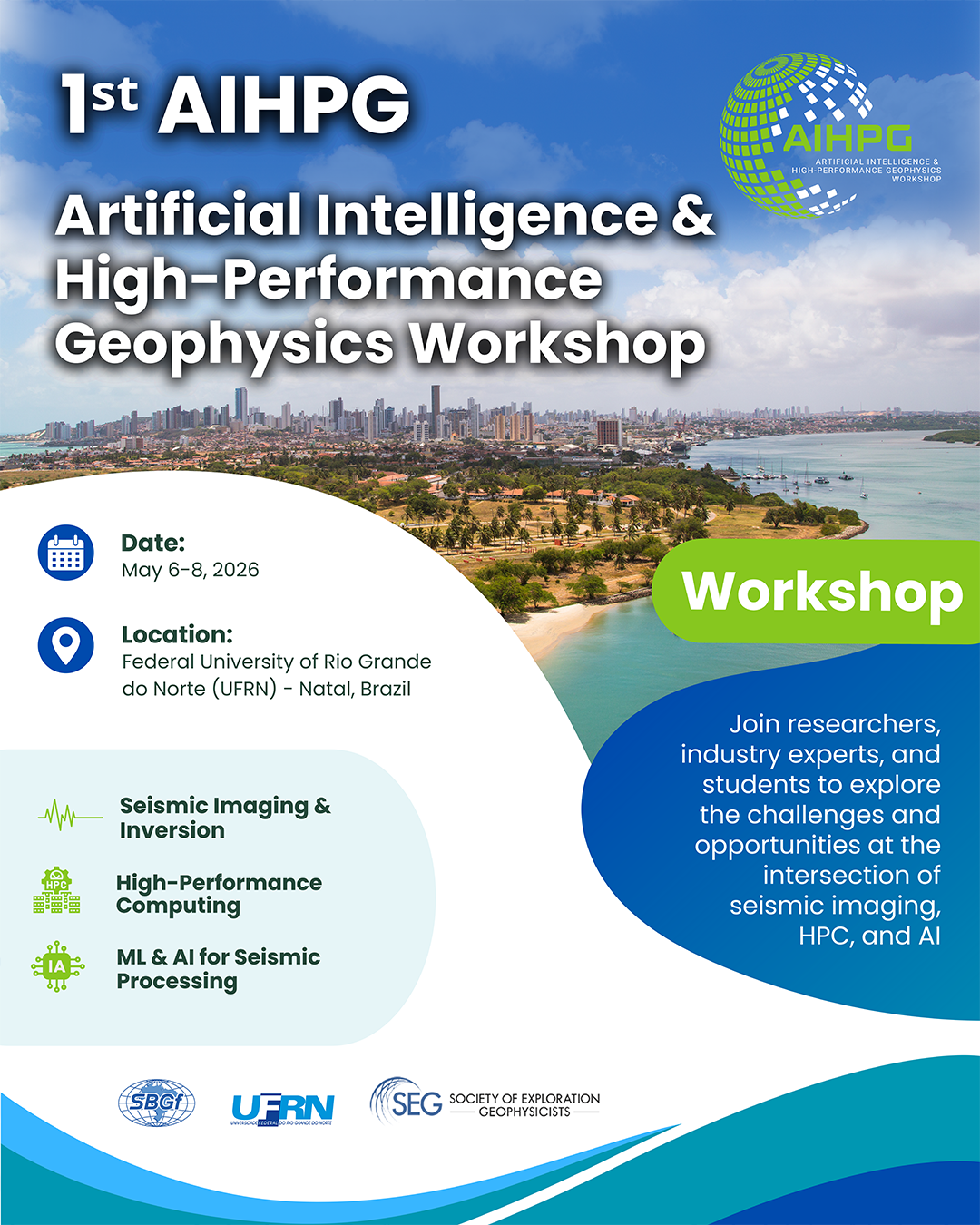
The First Artificial Intelligence & High-Performance Geophysics Workshop is an international forum organized by the Brazilian Geophysical Society (SBGF), the Society of Exploration Geophysicists (SEG), and the Federal University of Rio Grande do Norte (UFRN). The event brings together leading researchers, industry professionals, and practitioners to explore recent advances, emerging challenges, and innovative applications at the intersection of artificial intelligence, machine learning, and high-performance computing in applied geophysics.
Networking & Social Events
Join us and purchase an extra ticket for the event's icebreaker and/or dinner.
*Registered participants are already entitled to participate in these activities.
Seismic Imaging and inversion Powered by HPC and AI
Multiphysical Methods
Geology and Geophysical Integration
Petrophysics
AI and Computational Technologies in Applied Geophysics
High-Performance and GPU-Accelerated Computing in Geophysics
Pre-Event Short Courses
Important Notice: These courses are free for registered attendees! However, spaces are strictly limited to 20 spots per course. Secure your place early.
Short Course 01: Practical Machine Learning Methods in the Geosciences
Gerard Schuster (University of Utah) May 5 - From 8 A.M. to 6 Ρ.Μ. Duration: 8h. Intermediate Level.
Prerequisites (Knowledge/Experience/Education required): Some familiarity with Matrices, Vectors, Matrix Inverse, Calculus, Partial Derivatives.
The short course is for physical scientists who have heard about ML and might know some details, but lack enough knowledge to assess ML applications in their specialty.
Learning Outcomes
Diligent students will:
Learn how to apply ML methods to geoscience examples.
Understand key principles underlying each of the ML methods.
Practice manipulating MATLAB and Keras ML codes so they can adapt the codes to their own problems.
Understand limitations and benefits of each ML method.
Course Outline
Learn the high-level principles of five important topics in machine learning: neural networks; convolutional neural networks; support vector machines; principal component analysis; clustering methods. Practical examples in geosciences will be used to show applications of each method.
Practice the execution of these methods on MATLAB and Keras codes.
Teaching format is 50 minute lectures and 1-hour labs to reinforce principles of each method.
The short course is for physical scientists who have heard about ML and might know some details, but lack enough knowledge to assess ML applications in their specialty.
This limitation will be eliminated after two days of diligent attendance.
A selective overview of important ML topics is provided and their practical understanding comes from MATLAB exercises.
Machine learning examples are taken from the fields of astronomy, medicine, geosciences, and material sciences.
All participants will learn how to use ChatGPT or Deepseek to produce useful ML or Javascript codes that solve practical geophysical problems.
Short Course 02: Theoretical Foundations of Supervised and unsupervised machine learning algorithms in geosciences
Boris Platov (Kazan Federal University) May 5 - From 8 A.M. to 6 Ρ.Μ. Duration: 8h Graduate and post-graduate students, PhD candidates
Join us for an insightful lecture exploring the practical application of supervised and unsupervised machine learning algorithms in geosciences. Discover how these powerful tools can transform complex Earth science data into actionable insights.
Learning Outcomes
Diligent students will:
Regression: Predicting continuous variable values from known data points (e.g., estimating reservoir properties).
Classification: Determining discrete variable categories from observed data (e.g., lithology identification).
Clustering: Automatically grouping datasets into distinct classes without prior labels (e.g., seismic facies segmentation).
Featured algorithms include:
Linear & Logistic Regression.
Multilayer Perceptrons (Neural Networks).
Kohonen Self-Organizing Maps.
k-Nearest Neighbors (k-NN).
What makes this lecture unique?
We'll demystify ML "black boxes" through hands-on neural network calculations performed manually-no computers required! This exercise will deepen your understanding of core machine learning mechanics and their geoscientific relevance. We will do neural network training iteration and understand the back propagation algorithm. Machine learning becomes transparent when you master its foundations. Equip yourself with practical knowledge to leverage these techniques in your research!
×
New Short Courses
Free for registered attendees. Limited spots available!
Scroll down for details
×
Don't Miss Out
Paper submissions are closed, but you can still register to attend the event!